Napkin Ring Template, Utensil Pocket SVG
First Impressions: Delicate, Purpose-Built, and Surprisingly Versatile
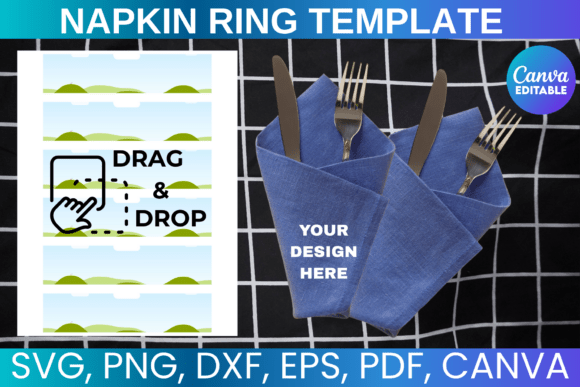
When I opened the Napkin Ring Template, Utensil Pocket SVG, my eye went straight to its clean silhouette—no fussy flourishes, no overcrowded motifs. It’s a functional shape with quiet elegance: a soft curve, balanced proportions, and subtle internal structure that suggests both utility and refinement. As an embroidery designer who’s stitched hundreds of tableware-themed pieces—from linen napkin wraps for wedding rentals to custom utensil pouches for boutique kitchen brands—I immediately recognized this as more than just a party favor template. It reads like a *designer’s sketch*, not a clip-art afterthought. The lines feel intentional, the negative space generous, and the scale inherently adaptable—whether you’re embroidering it onto a cotton tea towel or scaling it down for a baby bib.
Where This Design Earns Its Keep in Real Projects
I recently used the Napkin Ring Template, Utensil Pocket SVG as the centerpiece for a small-batch line of embroidered kitchen towels—each one personalized with a monogram beside the pocket. The result? Customers didn’t just comment on the stitching—they noticed how the design *held space*. Unlike busy floral borders or dense script, this template lets the fabric breathe while still anchoring the composition. It worked beautifully on midweight linen-cotton blends (my go-to for kitchen textiles), and the shape translated cleanly into satin stitch for the outer edge and light fill stitch for the pocket base. No thread nesting, no puckering—even at 3.8" wide. That’s rare for a design marketed as a Canva template but clearly built with real-world stitchability in mind.
It also performed well on other surfaces: as a minimalist patch on denim aprons (paired with contrasting thread), scaled down for baby spoon pouches (stitched on organic cotton muslin), and even reimagined as a cut-and-sew appliqué element on reversible tote bags. Because the original is an SVG, I could easily adjust stroke weight and spacing before converting to an embroidery file—giving me control over stitch density without losing clarity. That flexibility matters when you're balancing aesthetics with durability, especially for handmade products meant to be washed and used.
Use With Intention—Not Every Fabric or Surface Is Equal
That said, the Napkin Ring Template, Utensil Pocket SVG isn’t magic—it responds honestly to material choices. On thin or loosely woven fabrics (like lightweight rayon challis or delicate voile), I recommend adding tear-away stabilizer *beneath* and a light iron-on *on top* to prevent show-through or distortion. Stretchy knits? Skip it unless you’re willing to fuse interfacing first—the clean lines rely on stability. Dark fabrics demand careful thread selection; I tested navy twill with ecru and charcoal-gray threads, and the latter gave stronger definition without looking heavy. And if you’re stitching on curved surfaces—like the brim of a cap or the rounded corner of a pillow cover—test placement first. The open-ended shape doesn’t wrap naturally, so centering matters more than with circular motifs.
Also worth noting: while the design avoids tiny lettering or micro-details, the inner pocket seam line sits close enough to the outer edge that very dense fill stitches (or overly tight satin stitch) can blur the distinction. If you’re using this for commercial embroidery—say, for a café’s branded napkin set—review your digitizing settings for smooth transitions between stitch types. A slightly wider satin stitch margin or a 0.5mm running stitch outline helps preserve crispness across production runs.
What This Design Says About Your Brand—and Your Customers’ Experience
When a customer receives a finished product featuring the Napkin Ring Template, Utensil Pocket SVG, they don’t just get function—they get intentionality. There’s a quiet confidence in simplicity done well. I’ve seen Etsy buyers specifically mention “clean lines” and “thoughtful design” in reviews for items using similar templates. That perception lifts perceived value, supports premium pricing, and builds trust—especially for new craft businesses trying to stand out in saturated markets like personalized gifts or holiday merchandise.
For small shop owners and digital product sellers, this template also works double duty: use it as-is for physical goods, or adapt it into printable mockups for your Canva-based listings. Since it’s a Graphics asset, it integrates smoothly into branding kits—think coordinating labels, packaging inserts, or social media banners that echo the same gentle curve and rhythm. That consistency strengthens recognition across touchpoints, whether someone sees your embroidered tea towel in person or clicks through your Instagram shop.
Practical Designer Notes Before You Stitch
- Always test on scrap fabric first—especially if pairing with textured weaves or dark backgrounds.
- Check thread color contrast early: what reads as elegant on white may disappear on charcoal.
- Review stitch density in your embroidery software—if digitizing yourself, avoid overfilling the pocket base.
- Confirm hoop size compatibility; this design scales well, but extreme resizing affects stitch behavior.
- Inspect corners and curves in your preview mode—look for skipped stitches or abrupt direction changes.
- Test black-and-white mockups to assess visual weight and balance before committing to color.
- Use proper stabilizer: medium-weight cut-away for knits, tear-away for stable wovens, and water-soluble for sheer layers.
- Verify licensing terms before selling finished items or bundling the SVG into your own digital product—this is essential for Etsy sellers and craft business owners.
The Napkin Ring Template, Utensil Pocket SVG won’t shout—but it will hold attention. It’s the kind of design that earns repeat orders, shows up in styled flat lays, and quietly reinforces why customers choose handmade over mass-produced. Whether you’re stitching for a client’s bridal shower, building a cohesive line of boutique kitchen goods, or creating your next best-selling embroidery file for fellow designers, this is one template that delivers where it counts: in the stitch, on the fabric, and in the hand of the person who uses it.