Luggage Tag Template, Luggage Tag SVG — Canva Graphics
First Impressions: A Warm, Travel-Ready Design Asset
Opening this Luggage Tag Template, Luggage Tag SVG feels like unboxing a well-curated design kit for a boutique travel brand — not generic clipart, but a considered graphic design asset with intentional spacing, balanced negative space, and subtle texture cues. It leans into modern handmade business aesthetics: soft rounded corners, clean vector lines, and just enough decorative detail (like a minimalist strap loop or engraved-style border) to suggest durability without clutter. The mood is approachable yet polished — ideal for an Etsy shop launching personalized luggage accessories, a local travel concierge service, or a seasonal campaign for a small-batch luggage brand.
Where It Shines in Real Client Projects
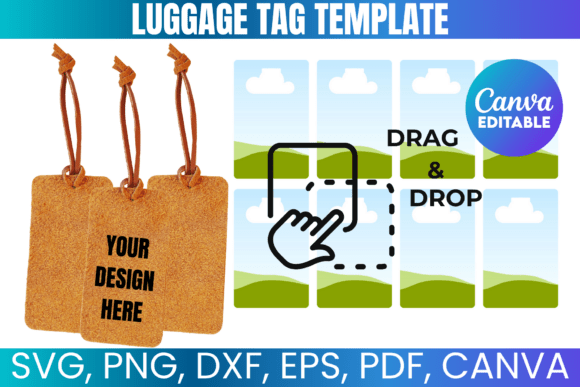
In my recent work for a coastal-themed artisan luggage line, I tested the Luggage Tag Sublimation Template across multiple touchpoints. It performed exceptionally well as a product mockup element — layered cleanly over suitcase renders in Photoshop, scaled confidently from 2” to 12” without pixelation. As a Canva editable luggage tag template, it streamlined client revisions: swapping colors, adjusting font pairings, and inserting custom monograms took under two minutes. For packaging design, it anchored gift-box tags and hangtags with visual consistency. In social media graphics, it became a recurring motif — resized as a watermark on Instagram Reels, cropped as a Pinterest pin icon, and repurposed as a sticker design overlay on blog visuals.
It also translated seamlessly into physical production: sublimated cleanly onto polyester luggage tags, cut precisely on Cricut projects using the SVG paths, and printed crisply at 300 DPI for retail shelf labels. As a personalized travel tag, its open layout accommodated both minimalist initials and longer destination names — critical for a client offering custom engraving.
Smart Applications Across Creative Disciplines
- Brand identity: Used as a supporting element in brand guidelines — not the logo, but a consistent visual anchor across email headers, packaging seals, and loyalty cards.
- Print-on-demand & Etsy product: Integrated into t-shirt design layouts, mug wrap templates, and tote bag mockups — especially effective when paired with complementary travel-themed illustrations.
- Marketing visuals: Served as a thematic frame for Facebook ads promoting summer getaways; added instant context without competing with headline copy.
- Editorial & web design: Applied as a subtle background repeat behind blog sidebars or as a decorative divider in newsletter layouts — its vector scalability ensured crisp rendering on all devices.
- Craft & Cricut project: Cut flawlessly from vinyl and heat-transfer material; the clean stroke weight prevented fraying during weeding.
Use With Intention — Not Everywhere
This Luggage Tag SVG isn’t a universal fix. It loses clarity below 1.5”, so avoid using it as a tiny favicon or app icon. In crowded layouts — say, alongside dense product specs or multi-font menus — it competes rather than complements. On low-contrast backgrounds (e.g., light gray on off-white), the subtle border fades, weakening visual hierarchy. It’s also mismatched for ultra-minimalist corporate branding (think law firms or fintech dashboards) where restraint means *no* decorative framing elements. And while charming for lifestyle brands, it reads as tonally inconsistent in formal invitations or B2B sales decks.
Designer Notes You’ll Actually Use
Before dropping this into a client file, run these checks:
- Test it in black and white — does the shape hold up without color cues?
- Preview on both light and dark backgrounds; some versions include subtle drop shadows that vanish on black.
- Scale it down to 1” and up to 24” — verify SVG paths remain smooth and PNG transparency stays clean.
- Place it on real product mockups (not just flat previews) — see how lighting interacts with its contours.
- Run a print test: check for unintended hairlines or anti-aliasing artifacts at edge transitions.
- Inspect file formats: confirm the SVG is truly vector-editable (not raster embedded) and that PNGs include alpha transparency.
- Pair it with fonts: it harmonizes best with friendly sans serifs (like Montserrat or Poppins), gentle scripts (for monograms), and clean display fonts — but clashes with heavy serif or technical monospace styles.
- Verify commercial license: this is a commercial design asset, but always cross-check usage rights for sublimation, POD resale, and digital redistribution — especially if bundling into a design bundle for your own shop.
Why It Earns a Spot in My Client Toolkit
What makes the Canva Editable Luggage Tag Template more than just another SVG design? It balances flexibility with fidelity. Unlike overly stylized clipart, it doesn’t impose a rigid aesthetic — instead, it provides structure that supports brand voice. When layered into a larger system — say, alongside custom icons, a cohesive color palette, and typography hierarchy — it strengthens recognition without dominating. Clients notice the polish: “It feels like part of a collection, not a stock add-on.” That emotional resonance — trust, warmth, intentionality — is what transforms a functional work badge or personalized travel tag into a memorable brand moment. For designers building scalable, human-centered visual systems for small businesses, handmade brands, or seasonal campaigns, this luggage tag sublimation template isn’t filler. It’s functional storytelling — quietly professional, warmly distinctive, and ready for real-world use.