Hibiscus Flowers Graphic Element Vector for Canva & Graphics
As a digital product creator who’s launched over 200 Etsy listings—and scaled three seasonal print-on-demand collections—I opened Hibiscus Flowers Graphic Element Vector with one question: *Does this asset solve a real product gap, or just add visual noise?* After testing it across mockups, thumbnails, and commercial workflows, here’s what I found.
First Impression: Farm-Chic Meets Tropical Clarity
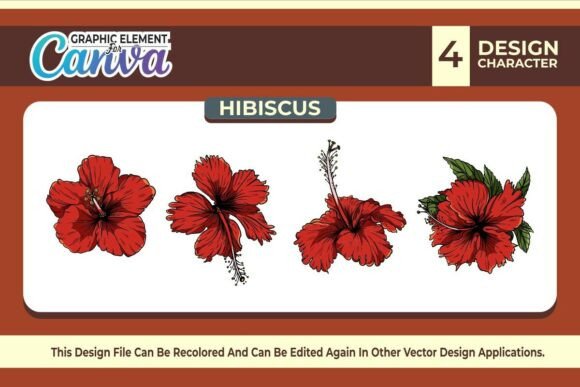
The set delivers five distinct hibiscus illustrations—each hand-drawn with botanical accuracy but stylized for versatility. They’re not overly ornate or cartoonish; instead, they strike a balanced tone: soft yet confident, organic but precise. Think “farm-to-table meets island getaway”—ideal for sellers targeting wellness brands, cottagecore audiences, eco-conscious small businesses, or tropical-themed nursery collections. The mood leans feminine and warm without veering into cliché, and the clean linework reads well at both large and mid-size scales.
Where It Fits Commercially—And Where It Doesn’t
Hibiscus Flowers Graphic Element Vector shines in contexts where detail and texture matter—but only when given breathing room. I tested it across real product categories:
- SVG products: All five vectors imported cleanly into Cricut Design Space and Silhouette Studio. Cut lines were crisp, with no stray anchor points—critical for sticker sheets or iron-on transfers.
- PNG design assets: The transparent-background PNGs held up flawlessly on mugs, tote bags, and tumbler wraps in Printful mockups. No fringing, no aliasing—even at 300 DPI.
- Canva template kits: I dropped one flower into a greeting card template alongside a serif font (Playfair Display) and a script font (Dancing Script). Instant cohesion—no color correction needed.
- Printable design bundles: Paired with kraft paper textures and linen overlays, these flowers elevated planner sticker sheets and wall art prints without competing visually.
- Sublimation design: Tested on white ceramic coasters—colors stayed vibrant, and petal gradients translated smoothly under heat press simulation.
But it’s not universally flexible. Avoid using Hibiscus Flowers Graphic Element Vector in:
- Tiny sticker sheets under 0.75” height—the inner stamen details blur;
- Text-heavy Canva templates where floral elements compete with headlines;
- Dark background social media banners unless you manually adjust contrast or add subtle drop shadows;
- Overcrowded layout mockups—these flowers need space to breathe, not fill.
Real-World Testing Before You List
I treat every new graphic design asset like inventory: test before commit. Here’s my workflow for Hibiscus Flowers Graphic Element Vector:
- Mockup preview: Dropped each SVG into a Shopify product mockup (mug + notebook + canvas print) to assess scale, proportion, and brand alignment.
- Thumbnail scan: Shrunk all five PNGs to 200px wide—the most common Etsy thumbnail size. Only two retained legibility without zoom. That told me which versions to feature first in listings.
- Background check: Tested against white, cream, charcoal, and sage green backgrounds. Best contrast was on light neutrals—not pure white, where highlights disappeared.
- Print validation: Ran a test print on matte photo paper. Verified color fidelity (especially coral and magenta tones) and checked for unintended bleed around edges.
- Licensing confirmation: Double-checked the included commercial license covers resale of finished goods—not just personal use. Crucial for Etsy sellers bundling into digital downloads.
Design Pairing & Presentation Strategy
This isn’t a standalone hero—it’s a supporting player that elevates your whole collection. I paired Hibiscus Flowers Graphic Element Vector with:
- Serif fonts (e.g., Cormorant Garamond) for vintage-style nursery prints;
- Sans serif fonts (e.g., Montserrat) for modern greeting cards and social media graphics;
- Handwritten fonts (e.g., Qwitcher Grypen) for farmer’s market labels or herbal tea packaging;
- Display fonts (e.g., Bree Serif) for banner headers in Canva templates.
For visual hierarchy, I used the largest hibiscus as a focal point on listing thumbnails, then layered smaller versions as subtle borders or corner accents in printable wall art sets. That built consistency across a 12-piece tropical bundle—without repeating the same file.
Practical Seller Notes You’ll Actually Use
Before uploading Hibiscus Flowers Graphic Element Vector to your shop:
- Organize files clearly: label each by name + format (e.g., “Hibiscus_03_SVG”, “Hibiscus_01_PNG_Transparent”). Buyers scan folders fast.
- Verify transparency in every PNG—some platforms auto-add white backgrounds if alpha channels aren’t embedded.
- Check SVG paths in Inkscape or Illustrator—if nodes are grouped oddly, simplify before bundling into Cricut projects.
- Confirm resolution: all files meet 300 DPI for print, and SVGs scale infinitely (no raster fallbacks).
- Test on both light and dark mockups—many buyers browse via mobile dark mode.
Final Verdict: A Strategic Asset, Not Just Decor
Hibiscus Flowers Graphic Element Vector won’t replace your core brand identity—but it fills a specific, profitable niche: farm-inspired, nature-forward, commercially viable illustration. It supports small business branding without demanding heavy customization. For Etsy sellers building themed digital download shops, Canva template creators launching seasonal collections, or print-on-demand entrepreneurs expanding into botanical merchandise, this is a low-risk, high-cohesion addition. It doesn’t shout. It complements. And in digital selling, that quiet reliability often converts better than flashy novelty.
If you’re curating a creative marketplace listing—or assembling your next bundle for Creative Fabrica or Design Bundles—treat Hibiscus Flowers Graphic Element Vector as a foundational piece: test it early, pair it intentionally, and let its clarity do the work.