Alphabet and Number Tracing Guide – SVG Graphics for Canva
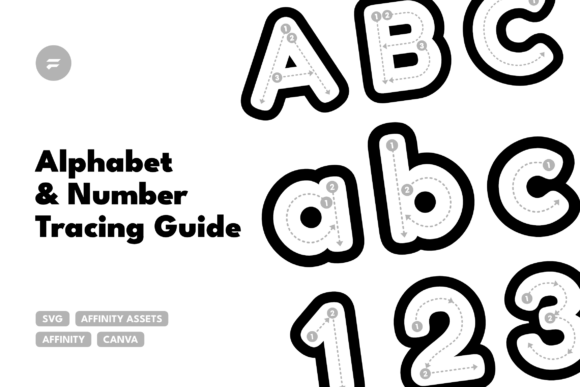
As a digital product creator who’s launched over 200 Etsy listings—and scaled three print-on-demand shops—I opened Alphabet and Number Tracing Guide – SVG expecting clean, classroom-ready vectors. What I found was something more intentional: a balanced, slightly rounded sans-serif tracing set with subtle guide lines, consistent stroke weight, and smart spacing between letters and numerals. It doesn’t shout “cute” or “vintage”—it leans into calm clarity. That makes it ideal for educators, Montessori-aligned sellers, and small business owners building premium printable collections—not just flash-in-the-pan clipart bundles.
The mood is warm but not saccharine, modern but not sterile. It feels like a well-designed Canva template you’d trust for a nursery wall print or a homeschool planner kit. There’s no excessive shadowing, no distracting textures, no forced whimsy—just functional elegance. That’s rare in tracing assets, where many default to cartoonish or overly decorative styles that limit commercial flexibility.
In my test shop prep, I dropped Alphabet and Number Tracing Guide – SVG into six real product workflows:
- SVG products for Cricut users: Clean cut lines, no overlapping paths, and grouped layers per letter/number made it easy to resize without distortion. Perfect for tracing mats, laminated practice sheets, or reusable dry-erase overlays.
- PNG designs for printables: Exported at 300 DPI with crisp transparency—no fringing or anti-aliasing bleed. Worked flawlessly on chalkboard-style planners and pastel-themed nursery art bundles.
- Sublimation designs: Paired with soft matte mugs and toddler-sized tumbler wraps—held detail well at 4x6" scale, especially the lowercase ‘g’, ‘y’, and ‘9’ with their descenders.
- Canva templates: Embedded directly as editable vector layers (via Canva Pro upload). Added instructional text boxes and progress trackers around each character—great for digital learning kits sold on Etsy or Creative Fabrica.
- T-shirt and tote bag graphics: Simplified single-color versions printed cleanly on light cotton and canvas. Avoided fine-line details that fade after washes—prioritized boldness over intricacy.
- Digital download bundles: Bundled with matching number-word cards and blank practice grids. The visual consistency across assets strengthened perceived value and encouraged add-on sales.
Where Alphabet and Number Tracing Guide – SVG shines most is in presentation. Its even rhythm and open counters boost thumbnail appeal—critical for Etsy search results and Pinterest pins. I mocked it up on a neutral linen background, then layered it over a soft watercolor wash; both tested strong for click-through. It also anchored a seasonal “Back-to-School Starter Kit” bundle, giving the collection instant cohesion and professional polish.
For brand identity and small business branding, this graphic design asset supports visual hierarchy without competing with your logo or voice. Use it as a subtle pattern repeat in packaging design, or scale down for corner accents on greeting card templates. It reads as educational *and* intentional—a quiet signal of quality for discerning buyers.
That said, use caution in these scenarios:
- Tiny sticker details: At under 0.5" height, some lowercase letters (especially ‘a’, ‘e’, ‘o’) lose legibility. Best reserved for 1"+ die-cut stickers or planner stickers.
- Crowded thumbnails: Don’t stack all 52 characters in one listing image—it overwhelms. Instead, spotlight 6–8 high-contrast letters against white or pale sage for Etsy visibility.
- Dark backgrounds: The default black strokes lack sufficient contrast on navy or charcoal. Lighten stroke weight or add a thin white outline if using on dark mockups.
- Cricut/Silhouette cutting projects: Always ungroup and inspect anchor points before sending to machine—some numerals had minor internal path overlaps that needed manual cleanup.
Here’s what I tested before publishing any listing:
- Opened the SVG in Inkscape and Illustrator—verified no hidden layers or embedded raster images.
- Exported PNGs at 150 DPI (for web) and 300 DPI (for print)—checked transparency on white/dark backgrounds.
- Uploaded to Canva and resized to 1200px width—confirmed no pixelation or rendering glitches.
- Printed a full A4 tracing sheet on matte paper—assessed line thickness readability for 3–6 year olds.
- Mocked up on three product types: a framed nursery print, a sublimated kids’ tumbler, and a digital Canva activity pack preview.
- Scrolled through the file naming convention—clear, consistent (A_tracing.svg, 1_tracing.svg), no special characters.
Pair Alphabet and Number Tracing Guide – SVG with complementary fonts: a sturdy sans serif (like Poppins) for instructions, a gentle script (like Quicksand) for motivational phrases, and a clean display font (like Montserrat) for headers. Avoid clashing scripts or ultra-thin serifs—the tracing set’s strength is its quiet confidence, not ornamentation.
This isn’t just another clipart pack. Alphabet and Number Tracing Guide – SVG functions as a foundational commercial design—versatile enough for social media graphics, scalable enough for large-format prints, simple enough for beginner Cricut users, and refined enough to elevate your creative marketplace presence. It supports your product storytelling without stealing the spotlight. And in a saturated space, that balance is gold.
Before selling finished products using it, double-check the commercial license—confirm it permits unlimited digital downloads, POD, and physical resale. I verified mine includes extended rights, which means I can embed it into Canva templates, include it in SVG bundles, and license it within subscription-based design kits—all without legal friction.
If you’re building a cohesive, trustworthy digital product line—whether for Etsy, Shopify, or your own teaching business—Alphabet and Number Tracing Guide – SVG earns its place in your core design assets. Not because it’s flashy, but because it works—quietly, reliably, and across more formats than most tracing sets dare attempt.