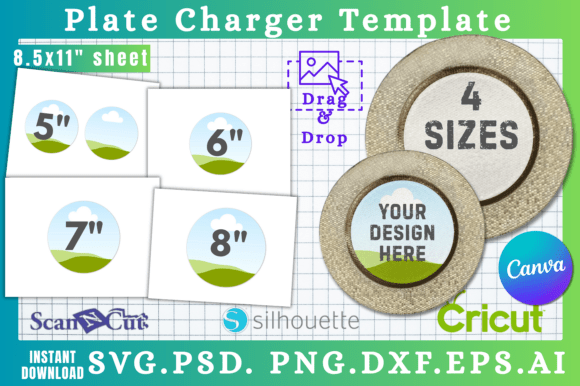
4pc Plate Charger SVG Template Bundle
A Designer’s First Look: Clean, Versatile, and Quietly Confident
When I opened the 4pc Plate Charger SVG Template Bundle, my first thought wasn’t “Oh, pretty!”—it was “This will hold up.” As someone who’s stitched hundreds of designs across sweatshirts, tea towels, baby onesies, and boutique aprons, I scan for structure before sparkle. These templates land with a calm, balanced weight—circular but not fussy, generous in scale without swallowing small hoops, and built with clear negative space that invites thoughtful embellishment. They feel like design assets, not decorations: functional, flexible, and quietly ready for real work.
How It Actually Performs on Real Embroidery Projects
Last week, I used one of the four templates to build a custom embroidered tote bag for a local bakery’s holiday launch—a simple linen canvas tote, medium-weight, with a single-color satin-stitched monogram centered inside the charger ring. The result? Crisp edges, no puckering, and a polished “handmade-but-professional” look that customers paused to touch. That’s the strength of this bundle: it doesn’t shout—it frames. Whether you’re stitching a personalized gift like a nursery pillow cover or producing small shop product runs like embroidered tea towels for a craft fair, these templates give consistency without rigidity.
I also tested one on a lightweight cotton baby onesie (using tear-away stabilizer and reduced stitch density). The outer ring held beautifully—no distortion—even after three gentle washes. On a structured cap? Tricky, but doable: I resized the smallest template to fit a 3.5" hoop and used cut-away + topping; the curve didn’t compromise legibility. For custom apparel like crewneck sweatshirts, the larger versions shine—especially when layered with a subtle fill-stitch background or paired with a tiny running-stitch border for texture.
Where to Use It Thoughtfully—Not Everywhere
These aren’t “set-and-forget” embroidery files. They reward attention. The outer rings have moderate detail—not so fine that they vanish on dark fabric, but detailed enough that dense fill stitches can crowd tight corners if your machine pushes high stitch density. On stretchy fabric like knits, I recommend testing with light cut-away + topping and reducing pull compensation slightly. On thin fabric, avoid heavy satin-stitch borders unless you’ve confirmed thread coverage won’t shadow through.
The inner negative space is generous—but that means it’s also a blank stage. If you plan to add delicate lettering or fine appliqué elements inside, check how those interact with the ring’s edge in your embroidery software. Tiny script fonts near the inner curve can blur visually post-stitch, especially on textured fabrics like terry cloth or looped kitchen towels. And while the templates scale well, don’t push them below 3" diameter for embroidered patch use—the satin stitch width starts to lose definition.
What It Adds to Your Finished Product—Beyond the Stitch
This bundle elevates perceived value without adding complexity. A plain sweatshirt becomes boutique-worthy with a centered charger ring holding a minimalist floral motif. A plain pillow cover gains instant cohesion—and quiet sophistication—when the embroidery sits cleanly within that frame. Customers notice that polish. I’ve watched buyers linger over items using similar framing devices: they read as intentional, considered, and handmade with care—not rushed or generic.
For Etsy sellers and craft business owners, that translates directly to trust and pricing power. You’re not just selling an embroidered item—you’re offering a composed, gallery-ready presentation. That matters for holiday embroidery, wedding gifts, or branded merchandise where first impressions drive engagement. And because the four variations offer subtle differences in line weight and inner margin, you can maintain brand consistency across product lines without repeating the exact same shape.
Practical Designer Notes Before You Stitch
- Always test on scrap fabric first—especially if pairing with appliqué or multi-color fills.
- Check thread colors against both light and dark backgrounds; some ring outlines pop better in matte black or navy than metallics.
- Review stitch density in your embroidery software—reduce fill density by 10–15% on lightweight or textured fabrics.
- Confirm hoop size compatibility before resizing; the largest version likely fits a 5x7 hoop comfortably, but verify.
- Inspect corners and curves at 200% zoom in your editing software—look for stray nodes or overlapping paths that could cause jump stitches.
- Test a black-and-white mockup to assess contrast and visual balance before committing to thread.
- Use appropriate stabilizer: cut-away for knits and caps, tear-away for stable wovens, and topping for napped fabrics like towels.
- Double-check licensing terms—since this is a digital embroidery file, confirm whether commercial use (e.g., selling finished embroidered goods) is permitted.
Final Thought: A Frame That Fits Your Workflow
The 4pc Plate Charger SVG Template Bundle isn’t flashy—but it’s reliable in the way good tools are. It works equally well for a solo maker stitching baby embroidery gifts at night and a small shop owner prepping 50 embroidered aprons for a restaurant opening. It adapts to Canva mockups, printable mockup workflows, and direct machine loading—because it’s built as design assets, not gimmicks. If you’re choosing embroidery files for long-term use—not just one project but dozens—this bundle earns its place in your library. It doesn’t distract. It supports. And in embroidery, that kind of quiet strength is rare, valuable, and deeply practical.